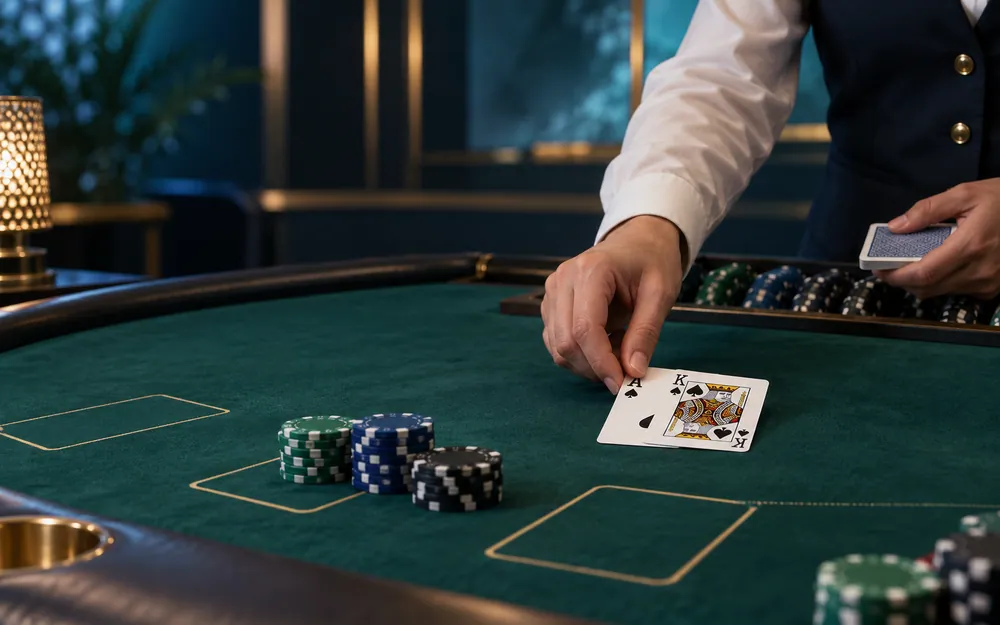
The game name is familiar, but the table is not automatically favourable. A six-deck game paying 3:2 for a natural blackjack is materially different from a table with a worse payout, restricted doubling or expensive side bets. Read the placard before buying chips and ask the dealer about any rule you cannot see.
Blackjack remains a priority visitor query because it is currently listed by major Australian casino venues, including Crown Melbourne and The Star properties. This guide covers physical casino play. It is not a route to an online casino, and the examples are for understanding cost and procedure rather than predicting results.
How one round works
Players place the main wager before cards are dealt. Number cards keep their face value, picture cards count as ten and an ace counts as one or eleven. After the initial cards, a player can usually hit, stand, double or split when eligible. The dealer follows fixed drawing rules rather than choosing freely.
A natural blackjack is an ace plus a ten-value card in the first two cards. Check the posted payout: 3:2 returns more than 6:5. Insurance is a separate wager offered when the dealer shows an ace; it is not protection for the original hand and should be evaluated as its own bet.
The rules that move the house edge
Deck count, whether the dealer hits or stands on soft 17, when doubling is allowed, whether split aces can be re-split and the blackjack payout all affect expected cost. A table can therefore be worse even when its minimum stake looks attractive. The approved rules and table sign matter more than a generic claim that blackjack has good odds.
Basic strategy is a rule-specific decision chart derived from the player hand and dealer up-card. It reduces the cost of guessing, but it cannot remove variance or promise a profit. If the available chart does not match the actual rules, ask the venue or use a conservative table-independent explanation only as preparation—not while slowing live play.
Splits, doubles and the real session budget
A displayed $20 minimum does not mean every round costs $20. Splitting creates a second wager, re-splitting can create more hands and doubling adds another equal wager. A player who arrives with exactly ten minimum bets may have far fewer than ten decision rounds once these options appear.
Budget for the maximum action you are prepared to take, not merely the opening wager. If using correct decisions would require more money than the session limit allows, the table is too expensive for that visit. Do not skip a sensible split or double solely to preserve an over-stretched session; choose a lower table or do not play.
Side bets, streaks and common myths
Pairs, suited combinations and other side bets often advertise large payouts, but they use separate paytables and commonly carry a higher edge than the main hand. Treat every side panel as another game. If you cannot find its approved rules and calculate what creates a win, leave it blank.
The dealer is not due to bust after several strong hands, and a new shoe does not owe the table a run of blackjacks. Card removal can change probabilities within a shoe, but casual streak observation is not a reliable advantage. Raising stakes because the table feels hot converts a story about recent cards into a larger financial exposure.
Live-table etiquette for a first visit
Wait for the dealer to finish the round and invite new wagers. Put cash on the table rather than handing it directly to the dealer, keep cards and chips inside the permitted area, and use clear hand signals because surveillance records the table. Do not touch a bet after the dealer closes wagering.
Ask before joining a mid-shoe table if the entry convention is unclear. Other players may have preferences, but their superstition does not control your legal decision. You are not responsible for making the dealer bust or for preserving someone else’s sequence. Be courteous, act at a reasonable pace and follow staff instructions.
A practical first-session plan
Choose a table whose minimum leaves room for a split or double, verify the natural-blackjack payout, avoid side bets and set both a cash limit and finish time. Watch one complete round before sitting so chip handling and hand signals are familiar. If alcohol is part of the night, play before drinking or skip the table.
Count the entire amount taken to the table as entertainment money that may be lost. A win does not expand the loss limit, and a loss does not create a debt that the next hand must repay. When the pre-set money or time boundary arrives, colour up and leave regardless of the last result.
- Read the rules placard
- Check 3:2 versus 6:5
- Leave room for splits and doubles
- Skip unexplained side bets
- Stop at the original limit
Where blackjack fits in an Australian casino trip
Blackjack is listed at major integrated resorts, but tables, minimums and hours change with demand. An official venue page can confirm that a game exists without confirming that a suitable table will be open when you arrive. Contact the property for current accessibility, entry and gaming-floor information.
The best use of the guide is to decide whether the pace and possible extra wagers fit your budget before travel. It does not rank a venue by the chance of winning. If a suitable table is unavailable, changing the night plan is safer than moving to a faster or more expensive game out of convenience.
Quick answers
Frequently asked questions
What is the best blackjack table rule to check first?
Check the payout for a natural blackjack, then the dealer soft-17 rule, deck count and doubling or splitting restrictions.
Can basic strategy guarantee a win?
No. It reduces avoidable decision errors under specified rules but does not remove the house edge or short-term variance.
Is card counting illegal?
Mental observation is different from using a device, but a casino can still restrict play or ask a patron to leave. Follow current venue rules and the law.
How much money should I bring?
Only an amount that can be fully lost without affecting essentials. Make sure the table minimum also leaves room for splits and doubles within that limit.
Primary sources
Check the current information
Rules, venue conditions and regulatory status can change. These links go to official organisations or the venue itself.