
WinCrown · Welcome bonus200 free spins on selected slots
Reviews (9,827)
4.9Rating
The complete list
 Best casinos available in AustraliaUpdated 8 November 2026
WinCrown · Welcome bonus200 free spins on selected slots
Reviews (9,827)
4.9Rating
Searching for an easy withdrawal online casino in Australia turns up speed claims measured in minutes, and almost all of them describe one stage of a five-stage process. Money can be taken out of an offshore casino account, and often quickly, but the quick part is the bank transfer at the end. The waiting happens before it, in the operator's own review and in identity checks — and that part is the one you can influence.
Conditions matter more than the headline. Payouts run in the account's base currency, which is frequently euros rather than Australian dollars; the withdrawal method usually has to be one registered in your own name, and often the same one that funded the account; prepaid vouchers cannot pay out at all; a minimum withdrawal and a per-request or monthly cap apply; and Australian banks screen gambling transactions in both directions, so a method that deposits successfully does not automatically pay out. Deposits and withdrawals are two separate checks — verify both before relying on either.
Not travelling to a venue?
Everything on this page is a licensed Australian property with a named regulator. If you are weighing up an online option instead, that is a different category with a different trade-off — compare the terms page, not the headline.
The phrase is used for three different claims, and only one of them is a property of the casino rather than of the banking system.
Sorting the three apart changes what you look for. A site can pay in a few hours and still be hard to withdraw from, because the documents were requested only once a payout was pending. Another can take two business days every time and be completely predictable. Over a year of play the predictable one causes fewer problems.
This page takes "easy" to mean the second claim: a payout path you can set up in advance and then rely on. Everything below is about where the delay actually sits and which parts of it you control.
Short answer: no. Australia licenses casinos one jurisdiction at a time, and every one of those licences is for a land-based property. There is no Australian licence for online casino games, and the Interactive Gambling Act 2001 makes it an offence to provide them to people in Australia. The offence belongs to the operator; the Australian Communications and Media Authority enforces it, including by asking internet providers to block sites.
So any online casino you can withdraw from is licensed somewhere else — Malta, the Isle of Man, Gibraltar, Curaçao or Kahnawake are the names that appear in footers — and that regulator is the only authority in the picture. No Australian regulator will take a complaint about the payout, and no Australian consumer remedy reaches it. The legal position in full is on the legality page, with the state-level detail on the laws by state page.
That single fact is why this page is structured around checking a payout path yourself rather than around rankings of payout speed. A speed claim with no enforcement behind it is a marketing figure, and the only version of it that means anything is the one you have already tested with your own money.
Licensed Australian online gambling does exist — wagering on sport and racing, lotteries and keno — and those operators answer to Australian regulators. How to check whether an operator is one of them is set out on the operator check page.
A withdrawal is not one event. It is five, run in order, and an advertised "instant" figure almost always refers to the fifth.
Read the table once and the advertising stops being confusing. Stage five is where PayID and crypto are genuinely quick. Stages two to four are where every complaint about a slow casino comes from, and two of those four respond to something you can do on your first day.
One more consequence worth planning around: stages three and four run on the operator's business hours in its own jurisdiction, not yours. A request submitted on a Friday evening Australian time can sit until the following week without anything being wrong.
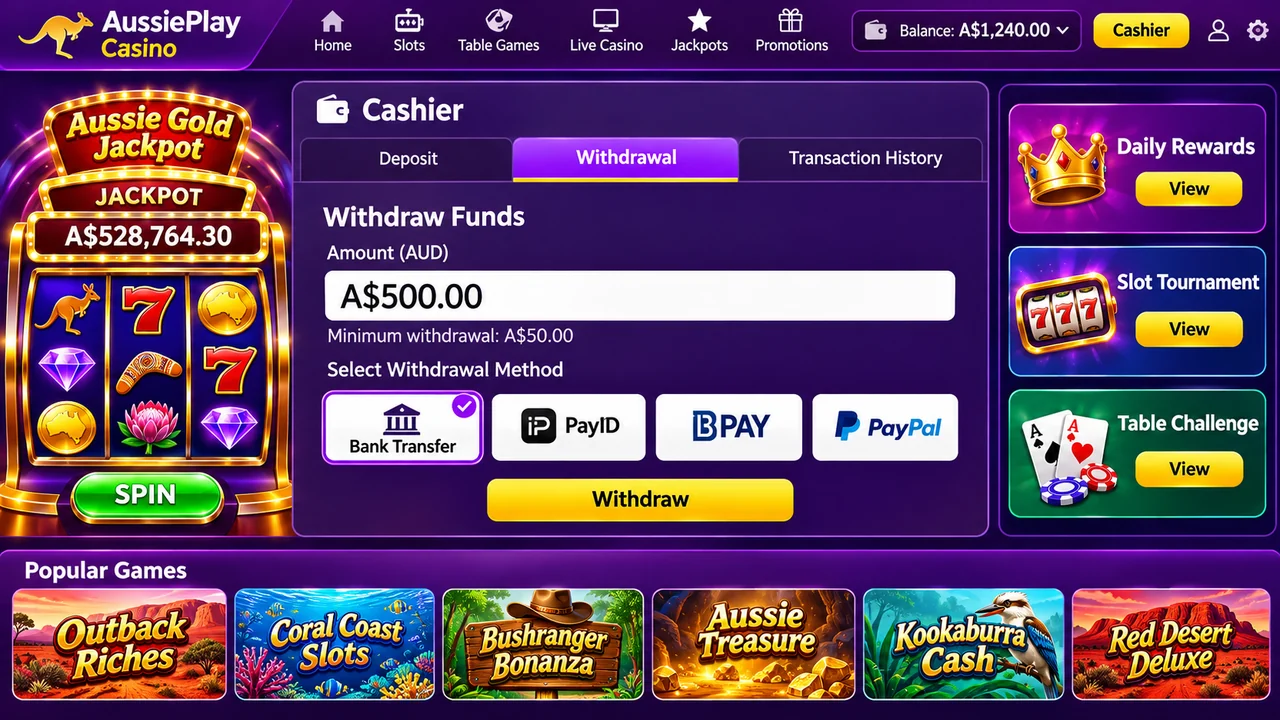
PayID is an addressing service on Australia's New Payments Platform, the rail that moves money between participating Australian financial institutions in close to real time, around the clock. When people describe an easy withdrawal, this speed is usually what they have in mind.
The important qualification is where that speed applies. The NPP carries money between Australian accounts. An offshore casino is not an Australian account holder, so a payout described as PayID generally reaches you through the operator's Australian payment partner — and the leg before that partner is not on the NPP at all. The fast part is real; it is just the last few seconds of a longer journey.
Two practical points follow. Whether a site can send to PayID depends entirely on its local payment arrangements, so it can stop working without notice when a provider changes. And some Australian banks screen or decline gambling-related transfers in either direction, which is a bank decision rather than a casino failure. Our full notes on the claim and how to read it are on the PayID page.
If a site lists PayID for deposits only, treat that as the answer to the withdrawal question rather than as an omission. Deposit support and payout support are configured separately, and the cashier is the only place that tells you which you have.
The rule that catches most first withdrawals. Anti-money-laundering obligations attached to the operator's licence push it to return funds to the source they came from, in the account holder's own name, which has three consequences in Australia specifically.
So the single most effective thing you can do for an easy withdrawal has nothing to do with choosing a fast casino. It is building the exit route on day one: a bank account, e-wallet or crypto wallet in your own name, registered on the account and verified while nothing is pending.
Do the documents at the same time. Photo identification, proof of address and proof of ownership of the payment method are the standard three, and the usual rejections are cropped images, screenshots instead of photographs, and documents older than the window the terms allow. What counts as acceptable proof of identity in an Australian context is on the identification page.
Four structural limits decide how much of a balance can leave and how fast. All four are published, none is negotiable, and they stack on top of each other.
Then there is batching. Many operators process payouts in runs rather than continuously, and the run follows business hours in the licensing jurisdiction. A request made at the wrong moment waits for the next batch, which is why the same site can honestly describe itself as paying within hours and still take three days for your particular request.
A large win has its own sequence of checks, and it is slower by design rather than by obstruction — set out on the large win page. Where a bonus is involved, the caps live in the promotional terms rather than the general ones, and both documents apply: see the bonus terms page.
Crypto is usually the fastest fifth stage available, because it skips the correspondent banking that makes international transfers slow. It does not skip stages two to four, which is the part most summaries leave out.
What it adds instead is a chain of your own. An exchange account, a wallet, a network fee, and a price that moves between the moment the casino sends and the moment you convert to Australian dollars. For a payout held for a day that movement can exceed any fee a bank would have charged, in either direction.
It also adds an irreversibility that bank transfers do not have. A transfer sent to a mistyped address is gone, there is no recall process, and the operator's support cannot retrieve it. Copy and paste the address, send a small test amount first if the site allows it, and check the network — the same wallet address on the wrong network is the most common way people lose a payout.
The trade-offs, including which coins see the fewest problems and what the Australian tax position is on converting them, are on the crypto page.
The only reliable information about a site's payout behaviour is the kind you generate yourself, and it costs one small transaction rather than a review of the marketing.
The four timestamps separate the stages for you. A long gap before the status changes is internal review; a long gap after "sent" is the payment rail; a request for documents at this point tells you verification was never actually complete. Any of the three is useful to know before a balance matters.
Keep the record. A screenshot of the terms on the day you accepted them, plus those four timestamps, is the entire evidence base any complaint process will ask for — and since there is no Australian authority to escalate to, your own file is the file. How we apply the same discipline to what goes on this site is on the editorial policy.
A payout that has not arrived has a short list of causes. Work through them in this order, because each rules out the ones below it, and none requires contacting support until the last step.
Only after those seven does a support ticket make sense, and then with specifics: the request reference, the four timestamps, the method and the amount. A ticket that says the payout is late invites a templated reply; a ticket that says a request made at a stated time has not changed status in a stated number of business days gets a person.
Set the expectation correctly, though. Support is the operator's own department, and if it does not resolve the matter, the escalation route is the licensing regulator named in the footer — the subject of the next section.
The uncomfortable part, and the reason this site keeps repeating the licensing point.
For a land-based Australian casino the answer is clear: each property is licensed by its own state or territory regulator, and a complaint goes there. For an online casino reachable from Australia there is no Australian regulator in the chain at all. The escalation path runs to the authority that issued the licence, and what that path is worth depends entirely on which authority it is: some publish a player-complaint process or name an alternative dispute resolution body, and some effectively do not.
So the check that belongs at the start, not at the end, is this: find the licence number in the footer, look it up in that regulator's own register rather than trusting a badge image, and read what the regulator says about player complaints. If there is no licence named, there is nothing to escalate to, and no payout speed makes up for that. ACMA can be told about a service offering prohibited interactive gambling to Australians, but it is an enforcement body rather than a recovery service — it will not get your balance back.
Everything on this site about where online play fits against licensed Australian venues is on the online casinos page and whether it is allowed at all, with the game side on the online pokies page.
Gambling is for over 18s and costs money rather than making it. Decide the amount before you start and treat a payout as money leaving the activity, not as a bankroll for the next session — budgeting is covered on the budget guide, and free confidential help through Gambling Help Online is listed with the other services on the responsible gambling page.
No independently verifiable answer exists, because the slow stages — the pending period, the internal review and compliance checks — happen inside the operator and are not observable from outside. Advertised speeds describe the payment rail only. The reliable method is to test a site yourself with one small withdrawal and record when each status changed.
Sometimes, and it depends on the operator's Australian payment arrangements rather than on PayID itself. The New Payments Platform moves money between participating Australian institutions in near real time, but an offshore casino reaches it through a partner, so the service can appear and disappear without notice. Some Australian banks also screen incoming gambling-related transfers.
Anti-money-laundering obligations attached to the operator's licence push funds back to their source, in the account holder's own name. The practical effect in Australia is that prepaid vouchers cannot pay out at all and declined cards cannot be used either way, so a separate withdrawal method in your own name has to be registered and verified first.
Almost every site sets one, and a balance below it cannot be requested. The options are to top the account up to the minimum, to play the remainder out, or to ask support whether a closing payment is possible. The minimum is published in the cashier or the terms, so check it before the balance gets small.
Until the stated processing window has passed, counted in business days in the operator's own jurisdiction. Before raising it, confirm verification is complete, no bonus or unmet turnover is holding the balance, the amount sits inside the caps, and no reversal returned the request to play. Then quote the request reference and the exact times.
Only the authority that issued the operator's licence, named in the site footer, because no online casino holds an Australian licence and no Australian regulator has standing. ACMA enforces the Interactive Gambling Act 2001 and can act against a prohibited service, but it is not a recovery service and will not return a balance. This is why the licence should be checked in the regulator's register before the first deposit.
Every property above is a physical building with a state or territory licence. No online casino appears because none can: under the Interactive Gambling Act 2001 an online casino service cannot lawfully be offered to, or advertised to, people in Australia, and ACMA states that online casino games and online pokies offered to Australians are prohibited. There is no Australian online casino licence for any operator to hold, including the companies that hold real land-based licences above.
That last point is the one most often misread. A company can operate a lawful casino in Melbourne or Sydney and still be prohibited from offering online pokies or online table games to Australian customers. The land-based licence is not a partial online licence. Online wagering on sport and racing is a different regime again, licensed at state level, which is why you see those advertisements on television and never see an online casino advertisement.
What offshore sites offer instead is convenience in exchange for the entire protective structure described on this page: no Australian regulator, no complaints path that ends with an Australian body, and a cashier you cannot stand in front of. If you want to see exactly what that trade looks like in writing, an operator's own terms page names the overseas regulator that would hear a complaint — and reading that name before depositing is the whole decision. Our online legality guide covers the law in detail.
Weighing up the alternative?
Fourteen licensed properties, eight regulators, one complaints path each. An offshore site has none of that. If you are going to compare, compare the terms.
Advertisement
Walking into Crown or The Star gets you an Australian regulator, a complaints path and a cashier you can stand in front of. An offshore site gets you none of those. If you still want to compare, start with its terms page.
Compare the options